
 ENGLISH
Wednesday, February 5, 2025, we welcomed an international team to CdA Can Santoi, composed of first-year Baccalaureate students from the Institut Teresa Pàmies, in Horta-Guinardó, and Erasmus+ program participants from Dunkirk, in Hauts-de-France. Their objective was to assess the current ecological state of the Vallvidrera stream.
First, they organized themselves into working teams and reviewed the necessary materials to conduct the field study. They examined both physico-chemical parameters (biotope) and biodiversity-related aspects (biocenosis) to determine the water quality of the stream.
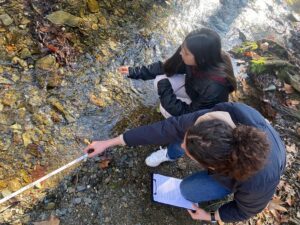
 Once at the stream, the teams collected a variety of data, including UTM coordinates, air and water temperature, width, depth, flow velocity, transparency, odor, granulometry, among others. They also took water samples for further analysis in the laboratory. Additionally, they assessed the conservation status of the riparian forest vegetation using the QRISI method. Finally, they dedicated time to capturing aquatic macroinvertebrates, which would later be used as bioindicators. They successfully collected a diverse range of organisms: mayfly larvae, dragonfly and damselfly larvaes, aquatic snails, freshwater limpets and shrimps, water crickets, and even a salamander larva!
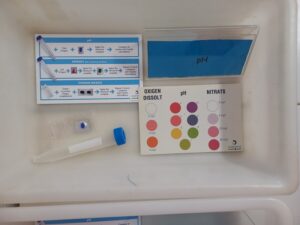
In the laboratory, they analyzed the water samples to measure parameters such as hardness, nitrite, nitrate, and phosphate concentrations, pH, dissolved oxygen, and conductivity (to determine mineralization) using the assessment kits from the Projecte Rius.
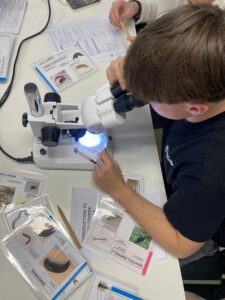
The captured macroinvertebrates were studied with the help of binocular magnifiers and identification charts to determine their biotic index. By combining this physico-chemical and biological information, they concluded that the water quality of the stream was mediocre.
To conclude, all the captured animals were safely released back into their habitat, where they will continue their life cycle!
Congratulations on a job well done! See you next time!
CATALÀ
Dimecres 5 de febrer de 2025, hem rebut al CdA Can Santoi un equip internacional format per estudiants de 1r de Batxillerat de l’Institut Teresa Pàmies d’Horta Guinardó i del programa Erasmus+ provinents de Dunkerque, a l’Alta França, per avaluar l’actual estat ecològic de la riera de Vallvidrera.
En primer lloc s’han organitzat en equips de treball i han revisat el material necessari per dur a terme l’estudi de camp, tant dels paràmetres fisicoquímics (biòtop) com dels referents a la biodiversitat (biocenosi), per poder determinar la qualitat de l’aigua de la riera.
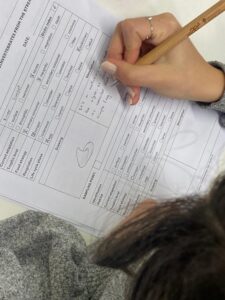 Un cop a la riera han recollit tot un seguit de dades organitzats per equips (coordenades UTM, temperatura de l’aire i de l’aigua, amplada, fondària, velocitat, transparència, olor, granulometria, etc.) i han agafat mostres d’aigua per completar l’anàlisi al laboratori. També han valorat l’estat de conservació de la vegetació del bosc de ribera (mitjançant el protocol QRISI). Finalment s’han dedicat a capturar macroinvertebrats aquàtics que posteriorment farien servir com a bioindicadors. Han aconseguit recol·lectar una bona diversitat d’organismes: larves d’efímera, de libèl·lula, d’espiadimonis, cargols aquàtics, barretets, gambes, grills d’aigua i, fins i tot, han pogut observar una larva de salamandra!
Al laboratori han analitzat les mostres d’aigua per calcular paràmetres com la duresa, la concentració de nitrits, nitrats i fosfats, el pH, l’oxigen dissolt o la conductivitat (per conèixer la mineralització) amb l’ajuda dels kits de valoració del Projecte Rius.
Han estudiat els macroinvertebrats capturats amb l’ajut de lupes binoculars i fitxes identificatives per determinar el seu índex biòtic. Amb tota aquesta informació fisicoquímica i biològica han determinat una qualitat mediocre de l’aigua.
Per acabar s’han tornat a alliberar sans i estalvis tots els animals capturats al seu hàbitat, on seguiran el seu cicle de vida!
Felicitats per la feina realitzada! Ens veiem aviat!